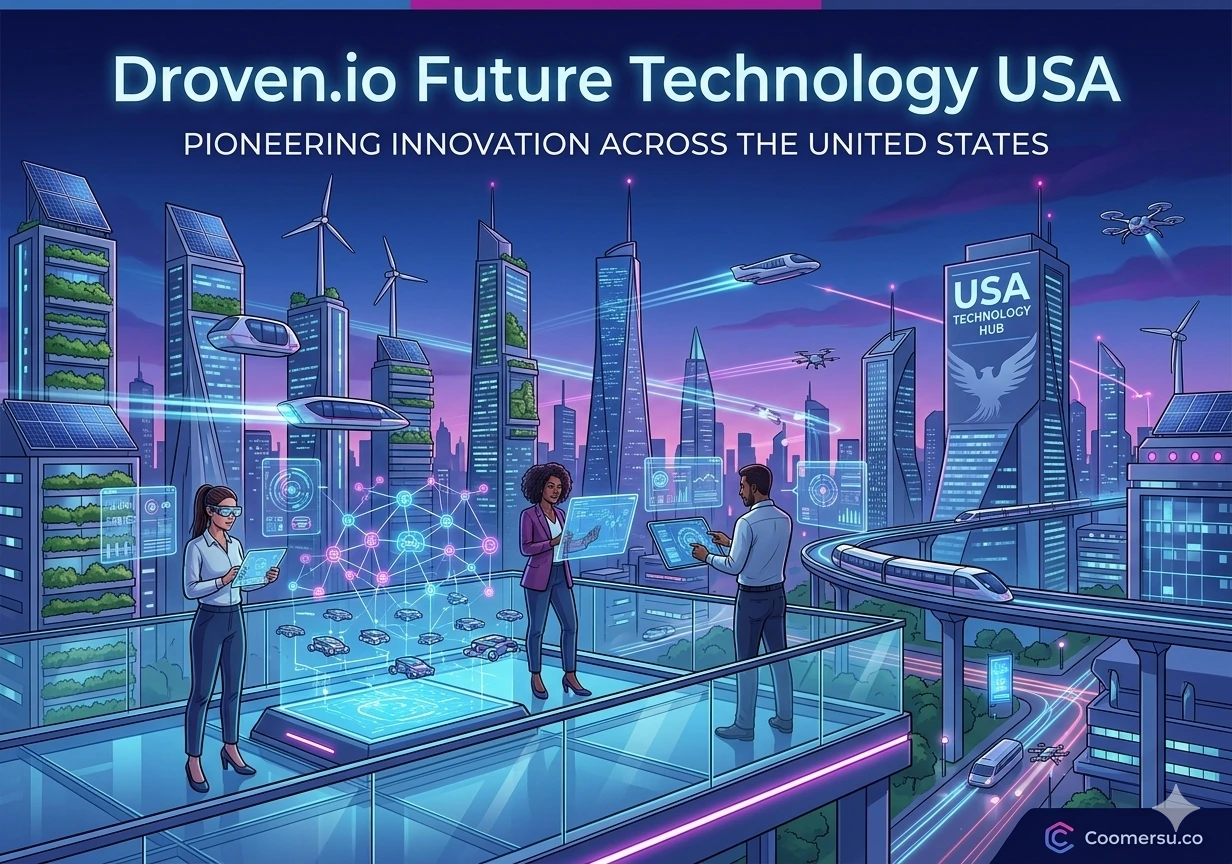
Droven.io Future Technology USA is a growing search topic connected to artificial intelligence, automation, cloud computing, digital transformation, and the future of work in America. As technology becomes part of daily life, many readers want simple explanations without heavy technical language. Droven.io appears to serve this need by presenting tech topics in a clear, educational format. For U.S. businesses, students, professionals, and startup founders, understanding these trends can help with better decisions, smarter tools, and stronger digital growth.
What Droven.io Future Technology USA Means
The phrase describes a broad technology idea rather than one single product. It connects Droven.io Future Technology USA with the wider movement of AI-powered innovation, automation, cloud systems, and smarter digital tools in the United States. Public pages describe Droven.io as an informational hub that simplifies topics like artificial intelligence, machine learning, automation, cybersecurity, and IT career development. This makes the topic useful for readers who want to understand where modern technology is moving.
At its core, the topic is about how digital systems are changing business and daily life. AI tools help companies analyze data, automation reduces repetitive tasks, and cloud platforms make software easier to scale. These technologies work together, not separately. For example, a retail company may use AI to predict demand, cloud software to manage orders, and automation to update inventory. Together, these systems create faster and more efficient operations.
Why This Topic Matters in the USA
The United States is one of the strongest markets for AI adoption, startup growth, cloud platforms, and business automation. Companies across healthcare, finance, retail, logistics, education, and manufacturing are using digital tools to solve real problems. This matters because technology is no longer limited to large corporations. Small businesses can now use cloud software, AI assistants, analytics dashboards, and automated workflows at a much lower cost than before.
For everyday readers, this topic also matters because technology affects careers, shopping, banking, communication, and learning. A customer service chatbot, a smart recommendation system, or an online payment alert may look simple, but each one depends on advanced digital infrastructure. When people understand these systems, they can make better choices as workers, customers, and business owners. That is why simple technology education has become more valuable.
The Role of Artificial Intelligence in Digital Growth
Artificial intelligence is one of the most important forces behind modern digital growth. It allows systems to learn from data, recognize patterns, make predictions, and support faster decisions. Businesses use AI for customer support, fraud detection, content creation, marketing, reporting, and forecasting. Droven.io Future Technology USA overview highlights AI for business as a way to improve productivity, decision-making, and operational efficiency.
AI for Business Decisions
In business, AI is most useful when it turns complex data into clear action. A sales team can use AI to identify strong leads. A warehouse can use AI to predict stock needs. A bank can use AI to detect unusual transactions. These examples show that AI is not only about futuristic robots. In many cases, it is about making normal work faster, safer, and more accurate.
AI for Customer Experience
AI also improves the customer experience by making services more personal and responsive. Online stores recommend products based on browsing behavior. Support systems answer common questions instantly. Marketing platforms send messages based on user interest. However, businesses must use AI carefully. Customers still want trust, privacy, and human support when issues are sensitive. The best companies combine automation with a human touch instead of replacing every interaction.
Automation and the Future of Work
Automation helps businesses reduce repetitive manual work. It can process forms, send emails, update records, create reports, track orders, and manage simple customer requests. Droven.io Future Technology USA describes automation platforms as digital systems that use RPA and AI-driven workflows to save time, reduce errors, and improve efficiency. This is especially useful for companies that handle large amounts of routine data every day.
How Automation Changes Jobs
Many workers worry that automation will remove jobs. In reality, the impact is more complex. Some repetitive tasks may disappear, but new roles also appear. Companies need people who can manage tools, check results, improve workflows, protect data, and communicate with customers. Instead of seeing automation only as a threat, workers can treat it as a signal to build stronger digital skills and move toward higher-value work.
Skills Workers Need
The future workplace rewards people who understand both technology and problem-solving. Useful skills include data analysis, AI tool usage, cloud basics, cybersecurity awareness, workflow design, and digital communication. Even non-technical workers can benefit from learning how automation tools work. A manager, marketer, accountant, or store operator does not need to become a software engineer, but they should understand how digital systems can improve their daily work.
Cloud Computing and Smart Infrastructure
Cloud computing is the backbone of many modern technologies. It allows companies to store data, run software, manage teams, and scale services without relying only on local servers. This is important for startups and small businesses because it lowers the barrier to using advanced tools. A company can launch an online store, manage customers, host files, and run analytics through cloud-based systems.
Why Cloud Supports AI
AI needs data, computing power, and flexible infrastructure. Cloud platforms make this easier by giving businesses access to storage, processing power, and connected applications. Without the cloud, many AI tools would be too expensive or difficult for smaller companies to use. This is why cloud computing and artificial intelligence are closely linked. Together, they make modern digital transformation more practical and scalable.
Edge Technology and Faster Responses
Cloud systems are powerful, but some situations need faster local processing. This is where edge computing becomes useful. Edge technology processes data closer to where it is created, such as in a factory, smart device, vehicle, or healthcare sensor. This can reduce delays and improve real-time decisions. As smart devices grow, edge computing will become more important for safety, speed, and reliable performance.
Cybersecurity and Trust in Future Technology
As businesses become more digital, cybersecurity becomes more important. Every online account, payment system, customer database, and cloud platform can become a target if it is not protected. AI and automation can help detect unusual activity, monitor threats, and respond faster. However, technology also creates new risks because attackers may use advanced tools too. Digital growth must always include strong security planning.
Trust is also a major part of technology adoption. Users want to know who creates content, how data is handled, and whether information is reliable. One competitor review notes that Droven.io appears to be a real and active website, but readers should evaluate content article by article because public ownership transparency is limited. This is a useful reminder for any technology platform or blog.
Startups, Innovation, and the U.S. Tech Ecosystem
Startups play a major role in shaping future technology. They often move faster than large companies and test new ideas in AI, cybersecurity, robotics, fintech, health tech, and software automation. Many successful technology trends begin as small experiments before becoming mainstream business tools. In the U.S., startup culture supports fast innovation, venture funding, and new digital services for both consumers and businesses.
Large technology companies also matter because they provide infrastructure, cloud platforms, chips, developer tools, and enterprise systems. Startups bring speed and creativity, while major companies bring scale and resources. Together, they push the U.S. technology ecosystem forward. For readers, this means the future will likely include more AI-powered tools, smarter apps, faster automation, and deeper integration between software and daily life.
Also Read: A Journey Through Sirbserbica: Unlocking the Secrets of This Enigmatic Culture
How Businesses Can Use These Trends
Businesses should not adopt technology only because it sounds modern. The best approach is to connect each tool to a clear business problem. A company may need faster customer support, better sales forecasting, stronger security, lower costs, or cleaner reporting. Once the problem is clear, leaders can choose the right mix of AI, automation, cloud software, and analytics.
Start Small and Measure Results
Small steps often work better than large, risky changes. A business can begin with one automated workflow, one AI reporting tool, or one cloud-based dashboard. Then it can measure time saved, errors reduced, customer satisfaction, and revenue impact. This practical approach makes digital transformation easier to manage. It also helps teams trust the technology because they can see real results.
Keep People Involved
Technology works best when people understand how to use it. Training is just as important as software. Employees should know what the tool does, where its limits are, and when human judgment is needed. A company that invests in both tools and people will usually get better results than one that only buys software. Human knowledge and digital systems should support each other.
Common Misunderstandings About Droven.io and Future Tech
One common misunderstanding is that Droven.io is a direct software product. Public information suggests it is better viewed as a content or knowledge platform, not a tool that users install or manage like SaaS software. Tycoonstory describes it as an editorial website with categories, dated articles, policy pages, and guest contribution options. This distinction helps readers set the right expectations.
Another misunderstanding is that future technology is only for experts. In reality, the topic affects many ordinary decisions. A student may use AI to learn faster. A small business may automate invoices. A job seeker may study cloud skills. A shopper may depend on fraud detection without noticing it. Future technology is not a distant idea. It is already part of modern American life.
FAQs
What is Droven.io?
Droven.io appears to be a technology-focused content platform that explains topics such as AI, automation, cloud computing, cybersecurity, and digital transformation in simple language.
Is Droven.io a software tool?
Based on public information, Droven.io is better understood as an editorial or knowledge platform, not a direct SaaS product or downloadable software tool.
Why is AI important for U.S. businesses?
AI helps businesses analyze data, improve customer service, automate tasks, reduce errors, and make faster decisions. It can support growth when used with clear goals.
How does automation help companies?
Automation saves time by handling repetitive tasks such as data entry, reporting, email workflows, customer replies, and inventory updates. It can also reduce human error.
Who should read about this topic?
Students, business owners, developers, professionals, startup founders, and general readers can benefit from learning about AI, automation, cloud systems, and future work trends.
Conclusion
Droven.io Future Technology USA shows how AI, automation, cloud computing, cybersecurity, and digital transformation are shaping the next stage of American business and work. Droven.io appears to support this conversation by making complex technology topics easier to understand. For readers, the main value is awareness. When people understand digital trends, they can choose better tools, build stronger skills, and prepare for change. The future of technology is not only about machines. It is also about smarter decisions, safer systems, and better human progress.
You May Also See: Coomersu